

Introduction
Introduction
The digital economy is expanding at an unprecedented pace, transforming how businesses operate, compete, and innovate. Technologies such as Artificial Intelligence (AI), Cloud Computing, Cybersecurity, Data Analytics, Automation, and DevOps are reshaping industries across the globe. As organizations accelerate their digital transformation initiatives, the demand for skilled IT professionals continues to rise dramatically.
However, while businesses are investing heavily in technology, many struggle to find qualified professionals capable of implementing, managing, and securing these modern systems. This challenge has created a significant IT skills gap that threatens productivity, innovation, and business growth.
According to industry reports, millions of technology-related positions remain unfilled worldwide due to a shortage of qualified talent. Organizations that fail to address this gap risk falling behind competitors, experiencing security vulnerabilities, and delaying critical digital transformation projects.
This blog explores the growing demand for skilled IT professionals, the causes of the IT skills gap, its impact on businesses, and practical strategies organizations can implement to bridge this challenge successfully.
Understanding the IT Skills Gap
Understanding the IT Skills Gap
The IT skills gap refers to the difference between the technical skills organizations need and the skills available in the current workforce.
As technology evolves rapidly, many employees find it difficult to keep pace with emerging tools, platforms, and methodologies. Meanwhile, educational institutions often struggle to update curricula quickly enough to meet industry demands.
The result is a mismatch between employer expectations and workforce capabilities.
Common Areas Experiencing Skills Shortages
Organizations frequently report shortages in:
Cybersecurity
Cloud Computing
Artificial Intelligence
Machine Learning
Data Science
Data Analytics
DevOps
Software Development
Network Security
Multi-Cloud Management
Automation
Enterprise Architecture
Digital Transformation Leadership
These specialized areas require continuous learning and practical experience, making talent acquisition increasingly difficult.
Why the Demand for Skilled IT Professionals Is Growing
Why the Demand for Skilled IT Professionals Is Growing
1. Rapid Digital Transformation
Businesses across industries are adopting digital technologies to improve operational efficiency and customer experiences.
From retail and healthcare to finance and manufacturing, organizations are modernizing legacy systems and implementing cloud-first strategies.
Digital transformation initiatives require professionals with expertise in:
- Cloud migration
- Infrastructure modernization
- Application development
- Data management
- Security implementation
As a result, demand for qualified IT professionals continues to increase.
Businesses across industries are adopting digital technologies to improve operational efficiency and customer experiences.
From retail and healthcare to finance and manufacturing, organizations are modernizing legacy systems and implementing cloud-first strategies.
Digital transformation initiatives require professionals with expertise in:
- Cloud migration
- Infrastructure modernization
- Application development
- Data management
- Security implementation
As a result, demand for qualified IT professionals continues to increase.
2. Rise of Artificial Intelligence
Artificial Intelligence is no longer a futuristic concept. Organizations are actively integrating AI into their operations for:
- Predictive analytics
- Customer support automation
- Fraud detection
- Intelligent decision-making
- Process optimization
The adoption of AI has created a growing need for professionals skilled in:
- Machine Learning
- Natural Language Processing
- Data Engineering
- AI Governance
- Generative AI Platforms
Companies seeking competitive advantages are aggressively recruiting AI talent.
Artificial Intelligence is no longer a futuristic concept. Organizations are actively integrating AI into their operations for:
- Predictive analytics
- Customer support automation
- Fraud detection
- Intelligent decision-making
- Process optimization
The adoption of AI has created a growing need for professionals skilled in:
- Machine Learning
- Natural Language Processing
- Data Engineering
- AI Governance
- Generative AI Platforms
Companies seeking competitive advantages are aggressively recruiting AI talent.
3. Expansion of Cloud Computing
Cloud technology remains one of the most significant drivers of IT hiring.
Organizations are migrating workloads to platforms such as:
- Amazon Web Services
- Microsoft Azure
- Google Cloud Platform
Cloud adoption requires professionals capable of:
- Designing cloud architectures
- Managing cloud security
- Automating deployments
- Monitoring performance
- Optimizing cloud costs
Certified cloud professionals are among the most sought-after technology experts today.
Cloud technology remains one of the most significant drivers of IT hiring.
Organizations are migrating workloads to platforms such as:
- Amazon Web Services
- Microsoft Azure
- Google Cloud Platform
Cloud adoption requires professionals capable of:
- Designing cloud architectures
- Managing cloud security
- Automating deployments
- Monitoring performance
- Optimizing cloud costs
Certified cloud professionals are among the most sought-after technology experts today.
4. Increasing Cybersecurity Threats
Cyberattacks continue to grow in frequency and sophistication.
Organizations face threats including:
- Ransomware attacks
- Data breaches
- Phishing campaigns
- Insider threats
- Supply chain attacks
To protect critical assets, companies require cybersecurity specialists who understand:
- Threat detection
- Incident response
- Security Operations Centers (SOC)
- Zero Trust Architecture
- Compliance frameworks
The cybersecurity workforce shortage remains one of the most pressing challenges worldwide.
Cyberattacks continue to grow in frequency and sophistication.
Organizations face threats including:
- Ransomware attacks
- Data breaches
- Phishing campaigns
- Insider threats
- Supply chain attacks
To protect critical assets, companies require cybersecurity specialists who understand:
- Threat detection
- Incident response
- Security Operations Centers (SOC)
- Zero Trust Architecture
- Compliance frameworks
The cybersecurity workforce shortage remains one of the most pressing challenges worldwide.
5. Growth of Data-Driven Decision Making
Data has become one of the most valuable organizational assets.
Companies use data to:
- Improve customer experiences
- Optimize operations
- Predict market trends
- Increase profitability
This has created significant demand for:
- Data Analysts
- Data Scientists
- Data Engineers
- Business Intelligence Professionals
Organizations need experts capable of converting raw data into actionable business insights.
Data has become one of the most valuable organizational assets.
Companies use data to:
- Improve customer experiences
- Optimize operations
- Predict market trends
- Increase profitability
This has created significant demand for:
- Data Analysts
- Data Scientists
- Data Engineers
- Business Intelligence Professionals
Organizations need experts capable of converting raw data into actionable business insights.
6. Automation and DevOps Adoption
Modern businesses seek faster software delivery and operational efficiency.
DevOps practices help organizations:
- Accelerate releases
- Improve collaboration
- Reduce downtime
- Enhance reliability
This drives demand for professionals skilled in:
- CI/CD pipelines
- Infrastructure as Code
- Containerization
- Kubernetes
- Automation tools
DevOps engineers have become critical contributors to digital transformation success.
Modern businesses seek faster software delivery and operational efficiency.
DevOps practices help organizations:
- Accelerate releases
- Improve collaboration
- Reduce downtime
- Enhance reliability
This drives demand for professionals skilled in:
- CI/CD pipelines
- Infrastructure as Code
- Containerization
- Kubernetes
- Automation tools
DevOps engineers have become critical contributors to digital transformation success.

Key Challenges Contributing to the Skills Gap
Key Challenges Contributing to the Skills Gap
Technology Changes Faster Than Training Programs
Technology evolves much faster than traditional educational systems.
By the time many programs update their curricula, newer technologies have already emerged.
Organizations often need skills that were not widely taught just a few years ago.
Technology evolves much faster than traditional educational systems.
By the time many programs update their curricula, newer technologies have already emerged.
Organizations often need skills that were not widely taught just a few years ago.
Limited Access to Specialized Training
Many employees lack access to structured training programs that align with modern business requirements.
Without continuous learning opportunities, skill development slows significantly.
Competition for Top Talent
Many employees lack access to structured training programs that align with modern business requirements.
Without continuous learning opportunities, skill development slows significantly.
Competition for Top Talent
Large enterprises frequently attract highly skilled professionals with competitive compensation packages.
Small and medium-sized businesses often struggle to compete for the same talent pool.
Aging Workforce
Large enterprises frequently attract highly skilled professionals with competitive compensation packages.
Small and medium-sized businesses often struggle to compete for the same talent pool.
Aging Workforce
Many experienced IT professionals are approaching retirement.
As they leave the workforce, organizations risk losing critical institutional knowledge and technical expertise.
Many experienced IT professionals are approaching retirement.
As they leave the workforce, organizations risk losing critical institutional knowledge and technical expertise.
Experience Requirements
Many organizations seek candidates with both advanced technical knowledge and extensive hands-on experience.
This creates barriers for entry-level professionals and limits available talent.
Many organizations seek candidates with both advanced technical knowledge and extensive hands-on experience.
This creates barriers for entry-level professionals and limits available talent.

Business Impact of the IT Skills Gap
Business Impact of the IT Skills Gap
The skills gap affects organizations in numerous ways.
Delayed Projects
Organizations may postpone digital transformation initiatives due to a lack of qualified professionals.
Project delays can reduce competitiveness and increase operational costs.
Increased Security Risks
Insufficient cybersecurity expertise can leave businesses vulnerable to attacks.
A single security incident can result in:
- Financial losses
- Regulatory penalties
- Reputational damage
- Customer trust issues
Reduced Innovation
Without skilled professionals, organizations struggle to adopt emerging technologies effectively.
Innovation slows, allowing competitors to gain advantages.
Higher Recruitment Costs
The shortage of qualified candidates drives up salaries and recruitment expenses.
Organizations often spend significant resources searching for specialized talent.
Employee Burnout
Existing IT teams frequently become overburdened when staffing shortages occur.
This can lead to:
- Increased stress
- Lower productivity
- Higher turnover rates
Strategies to Bridge the IT Skills Gap
Strategies to Bridge the IT Skills Gap
1. Invest in Corporate Training Programs
One of the most effective ways to address the skills gap is through employee upskilling and reskilling.
Organizations should develop structured training initiatives focused on:
- Cloud technologies
- Cybersecurity
- AI and Machine Learning
- Data Analytics
- DevOps
- Networking
Training existing employees is often more cost-effective than recruiting new talent.
One of the most effective ways to address the skills gap is through employee upskilling and reskilling.
Organizations should develop structured training initiatives focused on:
- Cloud technologies
- Cybersecurity
- AI and Machine Learning
- Data Analytics
- DevOps
- Networking
Training existing employees is often more cost-effective than recruiting new talent.
Benefits of Corporate Training
- Increased productivity
- Improved employee engagement
- Reduced hiring costs
- Better retention
- Enhanced innovation
- Increased productivity
- Improved employee engagement
- Reduced hiring costs
- Better retention
- Enhanced innovation
2. Create a Continuous Learning Culture
Learning should not be limited to annual training sessions.
Organizations should encourage continuous professional development through:
- Online learning platforms
- Certification programs
- Workshops
- Technical bootcamps
- Knowledge-sharing sessions
A learning culture helps employees remain current with emerging technologies.
Learning should not be limited to annual training sessions.
Organizations should encourage continuous professional development through:
- Online learning platforms
- Certification programs
- Workshops
- Technical bootcamps
- Knowledge-sharing sessions
A learning culture helps employees remain current with emerging technologies.
3. Support Industry Certifications
Professional certifications validate technical expertise and improve workforce capabilities.
Popular certifications include:
Professional certifications validate technical expertise and improve workforce capabilities.
Popular certifications include:
Cloud Certifications
- AWS Certified Solutions Architect
- Microsoft Azure Administrator Associate
- Google Professional Cloud Architect
- AWS Certified Solutions Architect
- Microsoft Azure Administrator Associate
- Google Professional Cloud Architect
Cybersecurity Certifications
- Certified Information Systems Security Professional (CISSP)
- CompTIA Security+
- Certified Ethical Hacker (CEH)
- Certified Information Systems Security Professional (CISSP)
- CompTIA Security+
- Certified Ethical Hacker (CEH)
Networking Certifications
- Cisco Certified Network Associate (CCNA)
- PCNSE
Certification programs help organizations build specialized expertise internally.
- Cisco Certified Network Associate (CCNA)
- PCNSE
Certification programs help organizations build specialized expertise internally.
4. Develop Internal Talent Pipelines
Rather than relying solely on external hiring, organizations should identify high-potential employees and create career development pathways.
This may include:
- Mentorship programs
- Leadership development
- Cross-functional training
- Technical specialization tracks
Internal talent development ensures long-term workforce sustainability.
Rather than relying solely on external hiring, organizations should identify high-potential employees and create career development pathways.
This may include:
- Mentorship programs
- Leadership development
- Cross-functional training
- Technical specialization tracks
Internal talent development ensures long-term workforce sustainability.
5. Partner with Corporate Training Providers
Specialized training providers can deliver customized learning solutions aligned with organizational goals.
Benefits include:
- Expert instructors
- Industry-relevant content
- Hands-on labs
- Certification preparation
- Customized learning paths
Organizations can accelerate workforce transformation through strategic training partnerships.
Specialized training providers can deliver customized learning solutions aligned with organizational goals.
Benefits include:
- Expert instructors
- Industry-relevant content
- Hands-on labs
- Certification preparation
- Customized learning paths
Organizations can accelerate workforce transformation through strategic training partnerships.
6. Strengthen University Partnerships
Collaborating with educational institutions helps organizations build future talent pipelines.
Partnership opportunities include:
- Internship programs
- Apprenticeships
- Industry projects
- Curriculum development
- Graduate recruitment initiatives
These collaborations ensure students gain practical skills before entering the workforce.
Collaborating with educational institutions helps organizations build future talent pipelines.
Partnership opportunities include:
- Internship programs
- Apprenticeships
- Industry projects
- Curriculum development
- Graduate recruitment initiatives
These collaborations ensure students gain practical skills before entering the workforce.
7. Embrace Skills-Based Hiring
Traditional hiring often prioritizes degrees over practical capabilities.
Organizations should focus on:
- Demonstrated skills
- Certifications
- Project experience
- Portfolio assessments
Skills-based hiring expands access to qualified candidates.
Traditional hiring often prioritizes degrees over practical capabilities.
Organizations should focus on:
- Demonstrated skills
- Certifications
- Project experience
- Portfolio assessments
Skills-based hiring expands access to qualified candidates.
8. Leverage Automation Strategically
Automation can help reduce pressure on understaffed IT teams.
Organizations can automate:
- Infrastructure provisioning
- Security monitoring
- Incident response
- Software deployment
- Routine maintenance tasks
Automation allows employees to focus on higher-value activities.
Automation can help reduce pressure on understaffed IT teams.
Organizations can automate:
- Infrastructure provisioning
- Security monitoring
- Incident response
- Software deployment
- Routine maintenance tasks
Automation allows employees to focus on higher-value activities.
The Role of Leadership in Closing the Skills Gap
The Role of Leadership in Closing the Skills Gap
Executive leadership plays a critical role in workforce transformation.
Leaders must:
- Prioritize workforce development
- Allocate training budgets
- Encourage innovation
- Support continuous learning
- Align skill development with business goals
Organizations that view training as a strategic investment rather than an expense achieve stronger long-term outcomes.
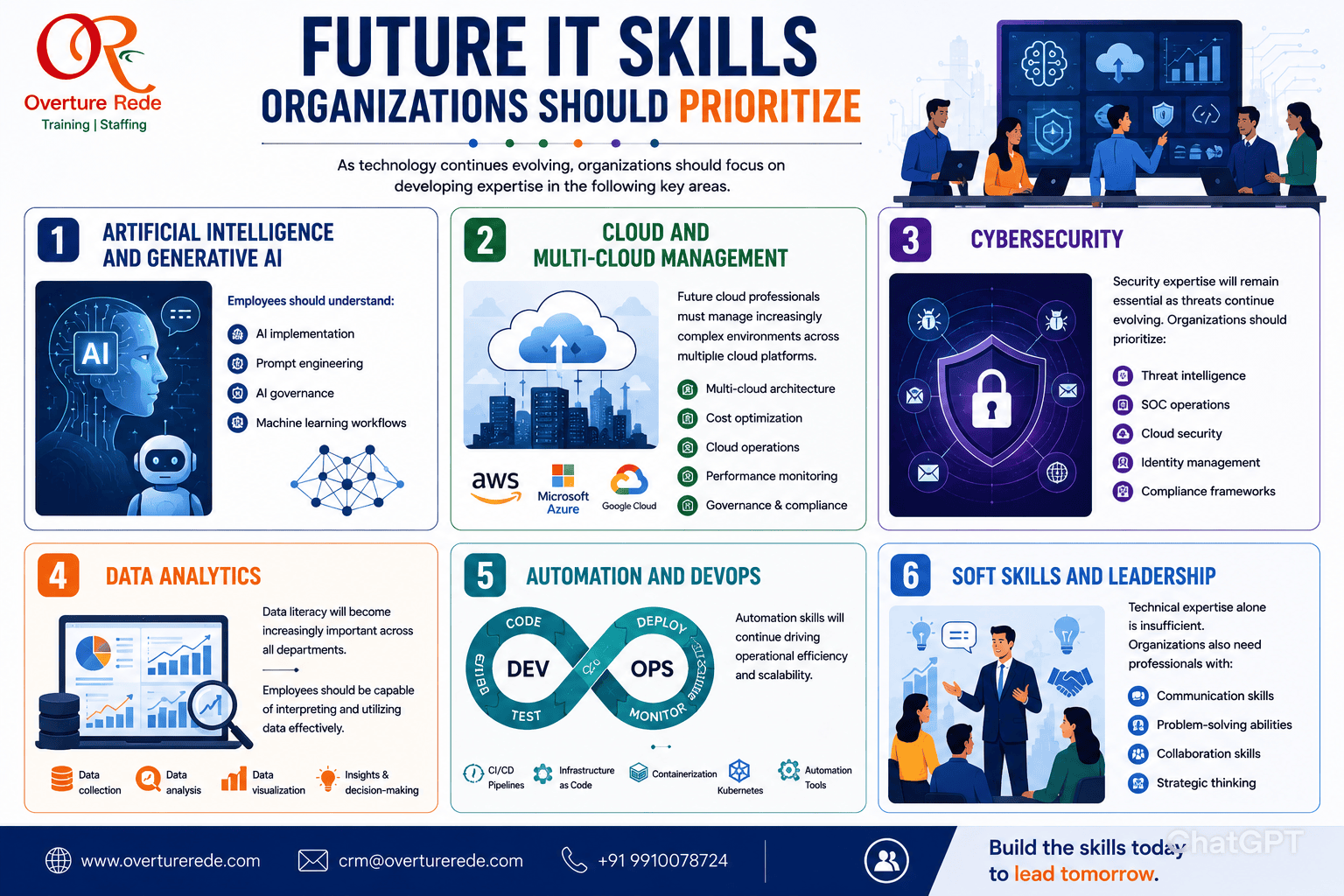
Future IT Skills Organizations Should Prioritize
Future IT Skills Organizations Should Prioritize
As technology continues evolving, organizations should focus on developing expertise in:
Artificial Intelligence and Generative AI
Employees should understand:
- AI implementation
- Prompt engineering
- AI governance
- Machine learning workflows
Future cloud professionals must manage increasingly complex environments across multiple cloud platforms.
Future cloud professionals must manage increasingly complex environments across multiple cloud platforms.
Cybersecurity
Security expertise will remain essential as threats continue evolving.
Organizations should prioritize:
- Threat intelligence
- SOC operations
- Cloud security
- Identity management
Data Analytics
Security expertise will remain essential as threats continue evolving.
Organizations should prioritize:
- Threat intelligence
- SOC operations
- Cloud security
- Identity management
Data literacy will become increasingly important across all departments.
Employees should be capable of interpreting and utilizing data effectively.
Automation and DevOps
Data literacy will become increasingly important across all departments.
Employees should be capable of interpreting and utilizing data effectively.
Automation and DevOps
Automation skills will continue driving operational efficiency and scalability.
Soft Skills and Leadership
Automation skills will continue driving operational efficiency and scalability.
Soft Skills and Leadership
Technical expertise alone is insufficient.
Organizations also need professionals with:
- Communication skills
- Problem-solving abilities
- Collaboration skills
- Strategic thinking
- Leadership capabilities
Technical expertise alone is insufficient.
Organizations also need professionals with:
- Communication skills
- Problem-solving abilities
- Collaboration skills
- Strategic thinking
- Leadership capabilities
Measuring the Success of Skills Development Programs
Measuring the Success of Skills Development Programs
Organizations should track measurable outcomes, including:
Training Completion Rates: Monitor employee participation and completion metrics.
Certification Achievement: Track the number of employees earning industry-recognized certifications.
Productivity Improvements: Measure operational efficiency gains following training initiatives.
Employee Retention: Upskilling opportunities often improve employee satisfaction and retention.
Business Performance: Evaluate how workforce development contributes to revenue growth, innovation, and customer satisfaction.
Conclusion
Conclusion
The demand for skilled IT professionals continues to rise as organizations accelerate digital transformation, cloud adoption, cybersecurity initiatives, artificial intelligence implementation, and data-driven decision-making. However, the widening IT skills gap presents a significant challenge that can impact productivity, innovation, security, and business growth.
Organizations that proactively invest in employee upskilling, certification programs, continuous learning, strategic partnerships, and talent development initiatives will be better positioned to overcome workforce shortages and remain competitive in an increasingly technology-driven world.
Bridging the IT skills gap is not simply an HR initiative—it is a business imperative. Companies that prioritize workforce development today will build the agile, resilient, and highly skilled teams needed to succeed in the future digital economy.

