

Cybersecurity Training: Why Every Organization Needs It
Cybersecurity Training: Why Every Organization Needs It
In the current digital-first environment of doing business, cybersecurity has become not an IT concern but a business priority. Businesses of any size find themselves under the unprecedented number of cyber threats, which include ransomware, phishing, insider threat attacks, supply chain attacks, cloud security threats, and AI-driven cyber crimes.
Even with significant investments in such cybersecurity technologies as advanced firewalls, endpoint security, intrusion detection systems, SIEMs, and cloud security solutions, one thing does not change—the biggest cybersecurity vulnerability—human errors.
As cybersecurity reports have found, in more than 80% of cases, successful cyberattacks take place due to such human errors as clicking on malicious links, weak passwords, accidental data disclosure, etc.
Therefore, Cybersecurity Training has become the necessary investment instead of an additional learning process.
By educating their employees, businesses minimize cyber risks, comply with regulations, preserve customer trust, and ensure business continuity.
At Overture Rede, we assist organizations in creating cyber-aware employees by offering various cybersecurity training courses tailored to any business role.
What is Cybersecurity Training?
What is Cybersecurity Training?
Cybersecurity Training refers to a training programme aimed at equipping employees with skills on how to detect, prevent, respond to, and report cyber threats before they affect the company.
Cybersecurity training involves both theoretical and practical aspects which equip the employees with safe cybersecurity practices.
Cybersecurity training usually covers areas such as:
- Cybersecurity Awareness
- Phishing attack prevention
- Password security
- Multi-factor Authentication (MFA)
- Email security
- Cloud security awareness
- Mobile Device Security
- Data Privacy
- Social Engineering attacks
- Secure Remote Work
- Incident Reporting
- Compliance with regulations
- Internet safety
- Ransomware Prevention
The aim is quite straightforward.
Make every employee the first line of cyber defence for the organisation.

Why Cybersecurity Training Matters More Than Ever
Why Cybersecurity Training Matters More Than Ever
Year after year, cyber criminals are getting more intelligent.
They do not just focus their efforts against large corporations any more.
Nowadays, the cyber criminals attack:
• small businesses,
• healthcare facilities,
• educational institutions,
• government departments,
• manufacturing firms,
• retail companies,
• financial organisations,
• IT firms,
• startups,
• NGOs.
Just one click from an employee on a phishing email can result in:
• data breaches,
• financial loss,
• ransomware attacks,
• customer information leakage,
• legal issues,
• non-compliance,
• reputation loss,
• downtime of business.
And cybersecurity training significantly helps avoid this.
Common Cyber Threats Organisations Face
Common Cyber Threats Organisations Face
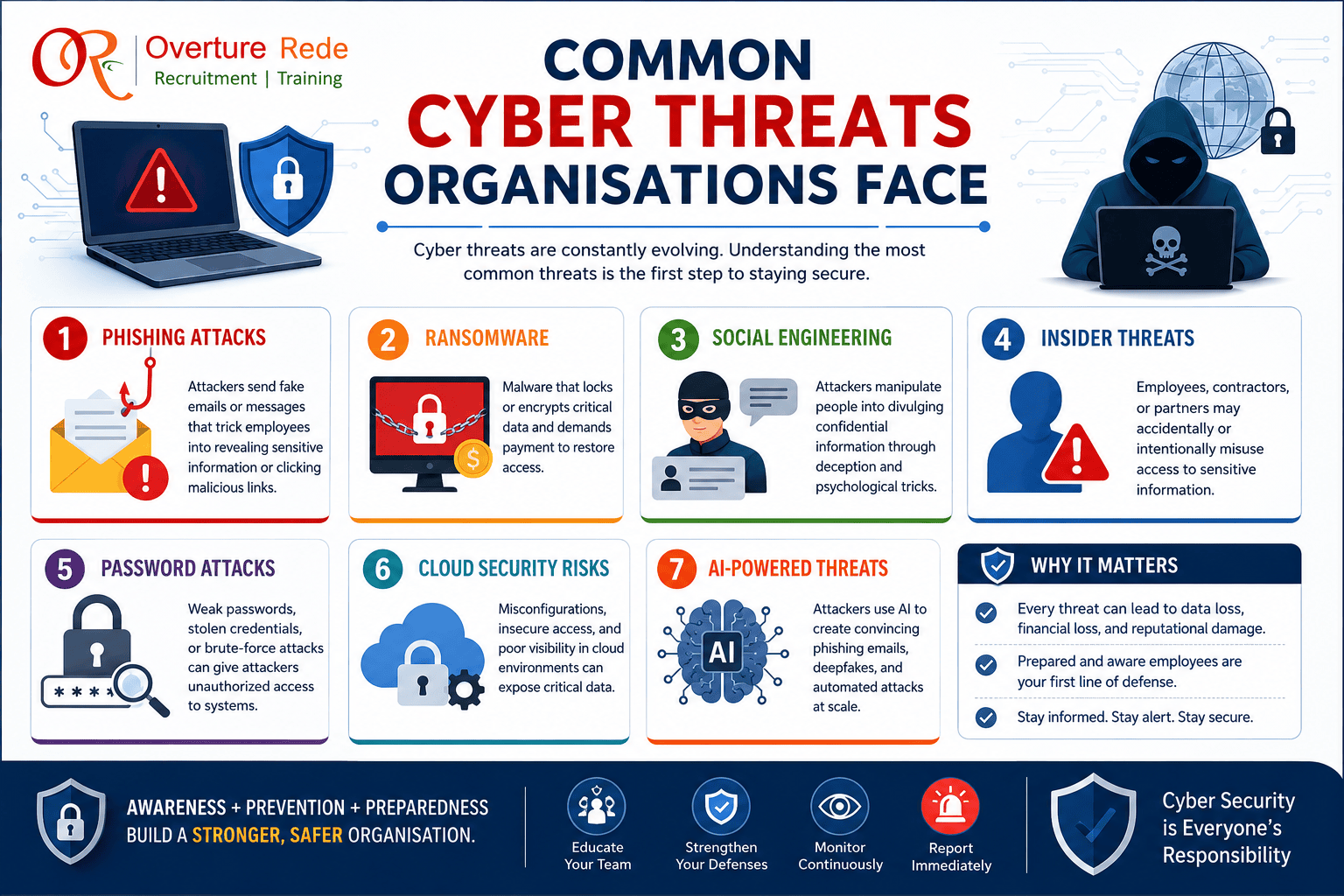
1. Phishing Attacks
Phishing emails deceive the employee by stealing passwords, sensitive information, or downloading malicious software.
Training employees to distinguish phishing emails reduces the likelihood of falling victim.
2. Ransomware
Hackers encrypt your data and ask for ransom.
Correct cybersecurity training will help employees detect unusual downloads and malicious emails before it infects their devices.
3. Social Engineering
The hacker manipulates your employee into leaking sensitive information through emails, phone calls, or impersonation.
Training teaches employees to verify the identity and protect themselves from manipulation.
4. Insider Threats
Threats are not always coming from outside.
The employee can accidentally expose sensitive information due to carelessness or poor behaviour.
Consistent training decreases this kind of risk.
5. Password Attacks
A weak password is still one of the easiest ways for hackers to enter.
Training promotes:
• The creation of strong passwords
• Usage of a password manager
• Multi-factor authentication
• Good credential management
6. Cloud Security Risks
Most organisations use Microsoft 365, Google Workspace, AWS, Azure, and other SaaS applications.
Employees require training regarding:
• Safe file sharing
• Correct cloud permissions
• Protecting the identity
• Safe collaboration
7. AI-Driven Cyber Attacks
The criminals now utilise Artificial Intelligence for conducting:
• Very believable phishing attacks
• Voice scams via Deep Fakes technology
• Malware creation using AI technology
• Automated attacks
Phishing emails deceive the employee by stealing passwords, sensitive information, or downloading malicious software.
Training employees to distinguish phishing emails reduces the likelihood of falling victim.
2. Ransomware
Hackers encrypt your data and ask for ransom.
Correct cybersecurity training will help employees detect unusual downloads and malicious emails before it infects their devices.
3. Social Engineering
The hacker manipulates your employee into leaking sensitive information through emails, phone calls, or impersonation.
Training teaches employees to verify the identity and protect themselves from manipulation.
4. Insider Threats
Threats are not always coming from outside.
The employee can accidentally expose sensitive information due to carelessness or poor behaviour.
Consistent training decreases this kind of risk.
5. Password Attacks
A weak password is still one of the easiest ways for hackers to enter.
Training promotes:
• The creation of strong passwords
• Usage of a password manager
• Multi-factor authentication
• Good credential management
6. Cloud Security Risks
Most organisations use Microsoft 365, Google Workspace, AWS, Azure, and other SaaS applications.
Employees require training regarding:
• Safe file sharing
• Correct cloud permissions
• Protecting the identity
• Safe collaboration
7. AI-Driven Cyber Attacks
The criminals now utilise Artificial Intelligence for conducting:
• Very believable phishing attacks
• Voice scams via Deep Fakes technology
• Malware creation using AI technology
• Automated attacks
Benefits of Cybersecurity Training
Benefits of Cybersecurity Training
1. Minimizes Errors by Humans
Humans are responsible for many cybersecurity incidents due to human error.
Training helps individuals to think before clicking, downloading or even sharing any information.
2. Safeguards Sensitive Information
Businesses possess sensitive information such as:
• Customers' information
• Financial information
• Employees' information
• Intellectual property
• Secrets of trade
Cybersecurity awareness will help secure this information.
3. Enhances Regulatory Compliances
In many industries, there is a need for security awareness training based on standards like:
• ISO 27001
• GDPR
• HIPPA
• PCI DSS
• SOC 2
• NIST Cybersecurity Framework
Training helps companies comply with regulations.
4. Minimizes Cost Losses
Cyber attacks lead to millions of dollars loss due to:
• Downtime
• Recoveries
• Legal costs
• Penalties for regulatory breaches
• Reputation management
Training is one of the best investments in security.
5. Increases Business Continuity
Employees trained in cybersecurity help to respond to cybersecurity incidents quickly.
6. Increases Customer's Trust
Customers today expect that businesses will safeguard their personal information.
It shows that a business is concerned about their security and privacy.
Humans are responsible for many cybersecurity incidents due to human error.
Training helps individuals to think before clicking, downloading or even sharing any information.
2. Safeguards Sensitive Information
Businesses possess sensitive information such as:
• Customers' information
• Financial information
• Employees' information
• Intellectual property
• Secrets of trade
Cybersecurity awareness will help secure this information.
3. Enhances Regulatory Compliances
In many industries, there is a need for security awareness training based on standards like:
• ISO 27001
• GDPR
• HIPPA
• PCI DSS
• SOC 2
• NIST Cybersecurity Framework
Training helps companies comply with regulations.
4. Minimizes Cost Losses
Cyber attacks lead to millions of dollars loss due to:
• Downtime
• Recoveries
• Legal costs
• Penalties for regulatory breaches
• Reputation management
Training is one of the best investments in security.
5. Increases Business Continuity
Employees trained in cybersecurity help to respond to cybersecurity incidents quickly.
6. Increases Customer's Trust
Customers today expect that businesses will safeguard their personal information.
It shows that a business is concerned about their security and privacy.

Essential Cybersecurity Topics Every Employee Should Learn
Essential Cybersecurity Topics Every Employee Should Learn
An ideal cybersecurity awareness training should include:
Password Security
• Creation of strong passwords
• Password managers
• Multi-factor authentication
Email Security
• Detecting phishing emails
• Attachment handling
• Email verification
Data Security
• Data classification
• Basics of data encryption
• Secure data sharing
Social Engineering
• Impersonation
• Phone scams
• CEO fraud
• BEC scams
Internet Safety
• Website verification
• Browsing safety
• Secure downloading
Remote Work Security
• Secure use of VPNs
• Risks of public Wi-Fi
• Device safety
Mobile Security
• Application permissions
• Mobile device encryption
• Lost mobile device safety
Cloud Computing Security
• Collaboration safety
• ID management
• Cloud computing shared responsibility
AI Security Awareness
• Deepfakes
• Phishing attacks using AI
• Prompt safety
• Responsible use of AI
Incident Reporting
Employees must be aware of:
• What needs to be reported
• When to report an incident
• To whom they should report
• How to report
Role-Based Cybersecurity Training
Role-Based Cybersecurity Training
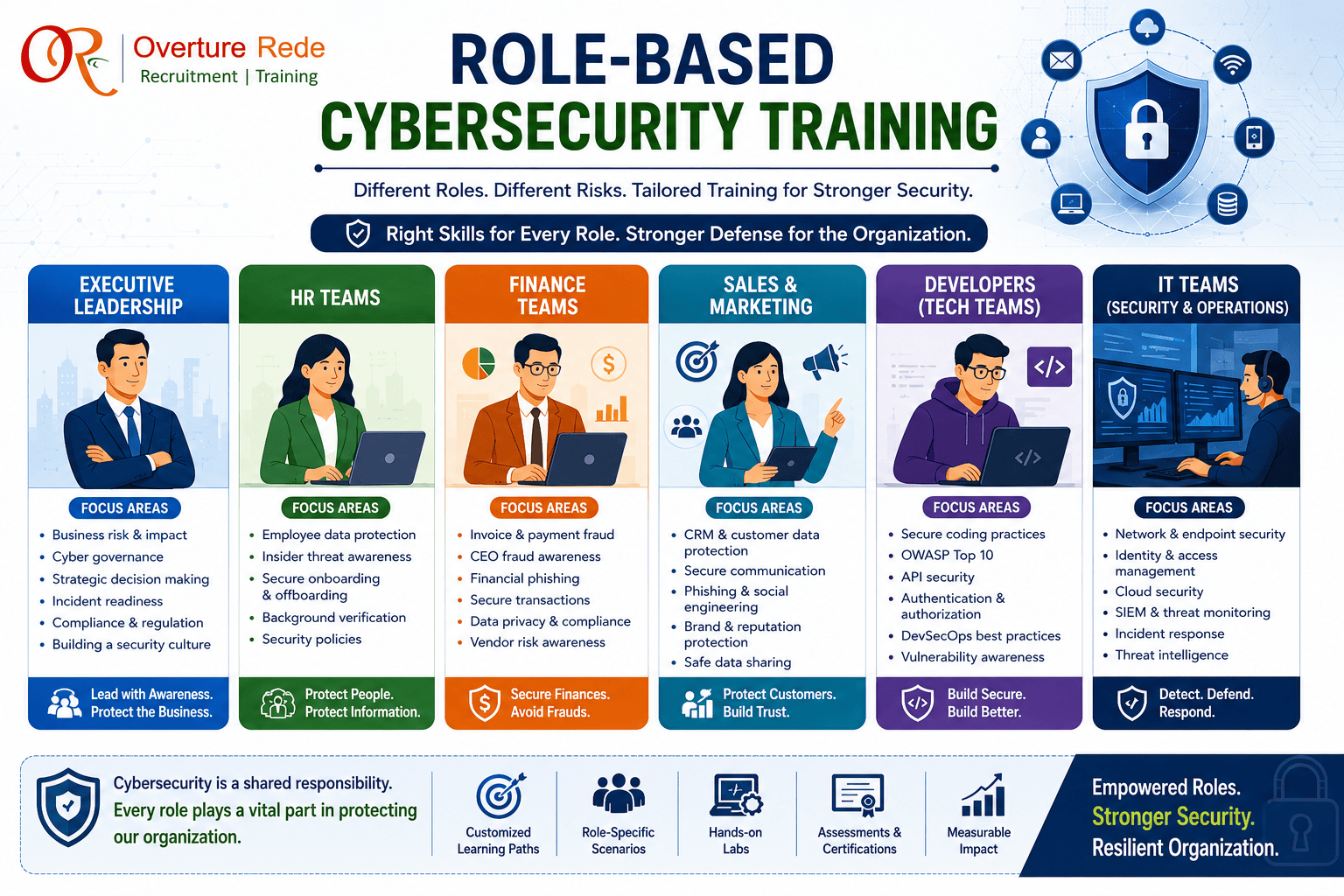
Cyber risks are varied for different types of employees.
Executive Leadership
The key focus areas are:
• Business risks
• Cyber governance
• Decision making in incidents
• Board level security
Human Resources (HR)
The main topics include:
• Employee data protection
• Insider threat
• Onboarding security
• Background verification
Finance Teams
Training is given on:
• Invoice fraud
• Payments fraud
• CEO fraud
• Financial phishing
Sales & Marketing
Main topics are:
• CRM security
• Customer data protection
• Communications security
Developers
The training includes:
• Secure coding
• OWASP top 10
• API security
• DevSecOps
IT Teams
Training includes:
• Network Security
• Endpoint Security
• Cloud Security
• Identity Management
• SIEM
• Incident Response
How Often Should Organisations Conduct Cybersecurity Training?
How Often Should Organisations Conduct Cybersecurity Training?
Training should not be done only once.
Recommendations for training schedule:
• New hire orientation
• Awareness training quarterly
• Phishing training monthly
• Certification annually
• Newsletters on security topics
• Hands-on training sessions
• Tabletop exercise
Cybersecurity is always changing.
Continuous education is important.
Signs Your Organisation Needs Cybersecurity Training
Signs Your Organisation Needs Cybersecurity Training
You must train your employees if your company is experiencing:
- frequent phishing attacks
- poor password management
- use of personal devices by employees
- remote workers
- cloud migration
- compliance issues
- customer data management
- lack of incident reporting
- high employee turnover
Best Practices for Effective Cybersecurity Training
Best Practices for Effective Cybersecurity Training
Some features that make up successful cybersecurity education programs are:
• Workshops
• Real-world attacks simulation
• Gamification
• Labs
• Scenarios
• Role-based learning pathways
• Assessment
• Monitoring progress
• Certification
• Updates
Cybersecurity Certifications Organisations Should Consider
Cybersecurity Certifications Organisations Should Consider
Professional certification programs help organisations build technical expertise.
Popular certifications include:
CompTIA Security+
Certified Ethical Hacker (CEH)
CISSP
CISM
CCSP
CompTIA CySA+
GIAC Security Certifications
Microsoft Security Certifications
Google Cybersecurity Professional Certificate
Cisco CyberOps Associate

Emerging Cybersecurity Trends in 2026
Emerging Cybersecurity Trends in 2026
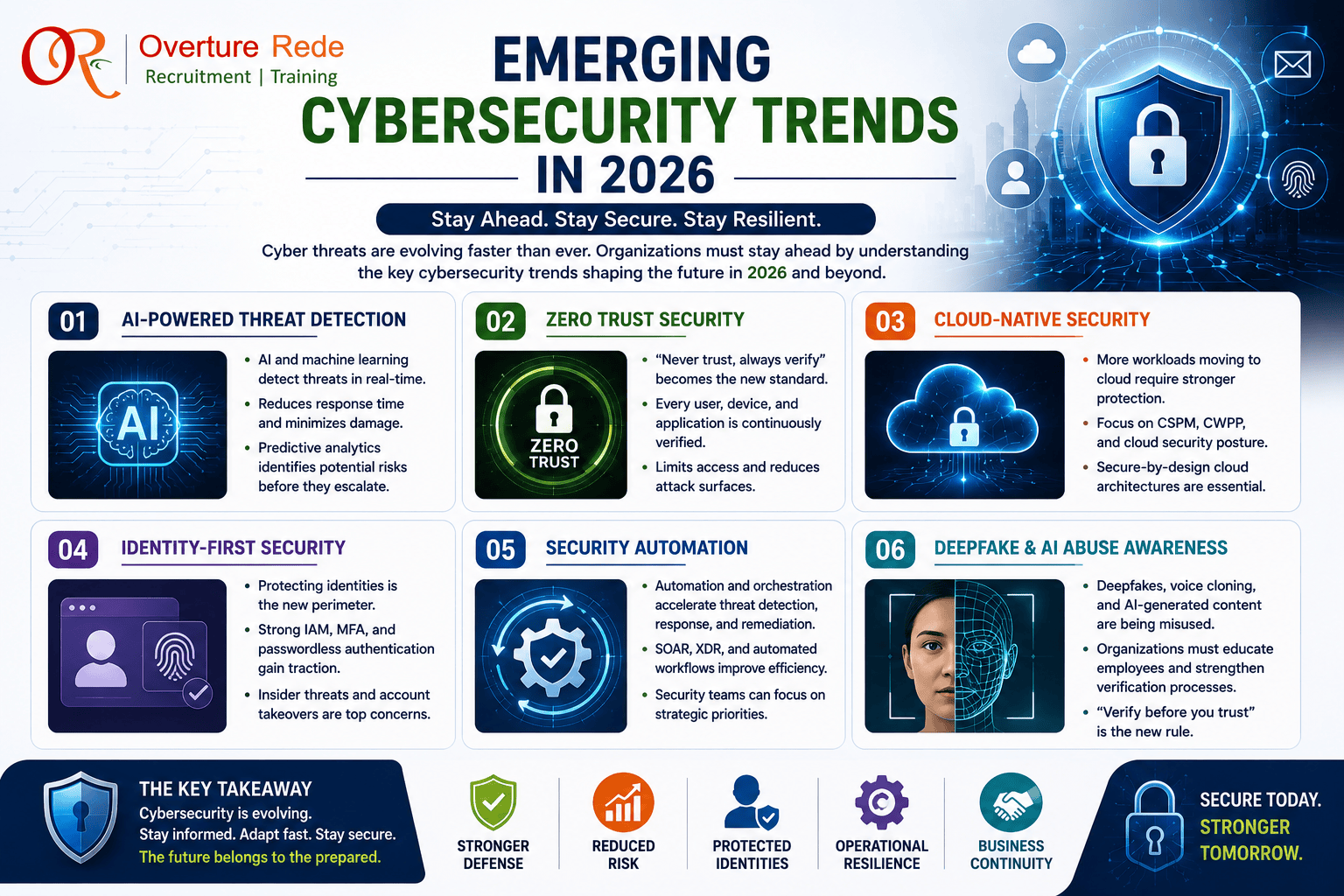
Organisations must educate their employees in preparation for:
AI-Powered Threat Detection
AI is used to detect any threat quicker than conventional security solutions.
Zero Trust Security
Organisations are embracing Zero Trust architecture, which does not trust anyone or anything.
Cloud-Native Security
With businesses moving to the cloud, there is a need for better cloud security skills among employees.
Identity-First Security
There has been an adoption of identity-based cybersecurity.
Security Automation
Organisations are using automation to combat threats quickly, allowing employees to work on strategic activities.
Deepfake Attacks
AI-based attacks have been growing rapidly, and employees need to be wary.
Before doing anything, they should check if the request is legitimate.
Measuring Cybersecurity Training Success
Measuring Cybersecurity Training Success
The following should be measured by organisations:
• Phishing simulations pass rate
• Employee assessment scores
• Reporting rates
• Increase in security awareness levels
• Compliance completion
• Training attendance
• Security incident reduction
• Employee feedback
• Audit performance
Measurement is continuous to improve future training initiatives.
Why Choose Overture Rede for Cybersecurity Training?
Why Choose Overture Rede for Cybersecurity Training?
We at Overture Rede offer industry-specific training services in cybersecurity designed for enterprise needs.
The programs offered by us comprise professional training, lab exercises, real-life case studies, and global best practices, which enable trainees to learn skills they can use right away in their respective organizations.
Our Cybersecurity Training Services
• Cybersecurity Awareness Training
• Secure Coding Training
• Ethical Hacking
• Penetration Testing
• Security Operations Center (SOC)
• SIEM Training
• Cloud Security (AWS, Azure, GCP)
• Identity & Access Management (IAM)
• Zero Trust Security
• Network Security
• Endpoint Security
• AI Security
• DevSecOps
• Compliance Training (ISO 27001, GDPR, PCI DSS, HIPAA)
• Incident Response
• Digital Forensics
• Risk Management
• Executive Cybersecurity Workshops

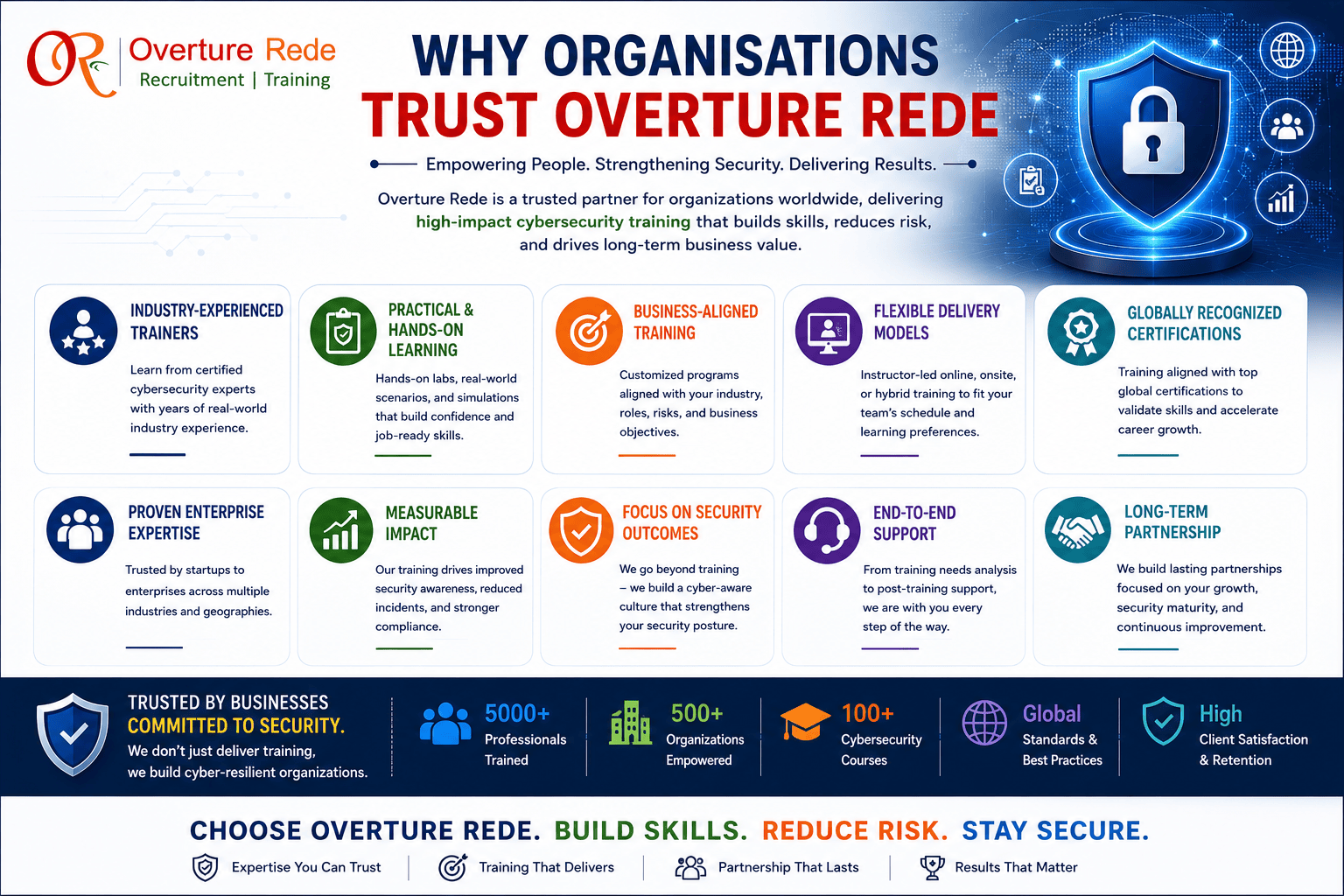
Why Organisations Trust Overture Rede
Why Organisations Trust Overture Rede
Industry Certified Trainers
Customized Corporate Learning Program
Lab Environment
Instructor Led Online Training as well as Onsite Training
Scheduling Flexibility
Deployment across the Entire Organization
Post Training Assessments
Certificate upon Completion
Role Based Learning Modules
Continuous Support and Consulting
Be it a startup looking to develop its first Cybersecurity Awareness Training or an organization aiming to enhance its security, Overture Rede offers scalable training programs based on your organizational objectives.
Conclusion
Conclusion
Cybersecurity is not just technical; it is about people, process, and preparation. Every person, from the receptionist to the CEO, is a critical part of ensuring the protection of an organisation’s digital resources.
Training on cybersecurity benefits organisations by making employees aware of cyber dangers and equipping them to help create a culture of cybersecurity. It helps reduce risks, ensures compliance, builds customers’ trust, and makes organisations more resilient in a networked age.
With ever-evolving threats to cybersecurity, organisations that invest in continuous cybersecurity training will be able to counter those threats more effectively.
Work with Overture Rede to arm your staff with the skills and expertise to help protect your organisation against cyber threats.

